Monday, March 31, 2008

Website Hosting: Explicit Time, Explicit Space

Most website hosting companies operate on an explicit time and explicit space basis. Due the to medium that most customers use to find a host (the internet), it is very easy to compare prices between companies. Some hosts have tried to package their offerings together now as a way to counter the increased clarity of pricing, or have added additional benefits that they believe to be valuable to their customers. Depending on the client, in addition to the value of space given for the price, benefits such as close to 100% network uptime, a dedicated vs shared server, email addresses, and customer support will also play a role in the ultimate package chosen. Customers are traditionally renting this server space for a fixed amount of time – usually monthly, though discounts might be given for renting for a longer amount of time. From the host’s perspective, if their server space goes unused, that is money left on the table. Website hosts can generally add some additional server space at not much cost, but generally won’t keep buying/selling servers to match customer demand (in part because of higher costs to refit the entire system to keep up with increased bandwidth, etc). Below are four examples of website hosts, each using a slightly different model to attract customers.

Network Solutions uses a traditional package approach. Offering three main packages, customers can choose between the amount of disk space, monthly data transfer, FTP accounts, and e-mailboxes. Packages range between $9.96 and $29.13 monthly and come with a free domain, with an annual contract. Prices go up a few dollars per month without the annual contract.

GoDaddy is another popular website host provider. Here, their pricing is focused on the amount of disk space, monthly data transfer, number of email addresses, total email storage, and a few smaller items (no long term contract required). While GoDaddy’s initial prices appear cheap at $4.29-$14.99 per month, this doesn’t include much more than the bare minimum. Like RyanAir’s approach to airline pricing, GoDaddy includes the minimum at a low price and charges customers for any add-ons that they require (such as domain registration/renewals).

Geocities (owned by Yahoo) is a website provider geared more to the beginner designer. Unlike Network Solutions and GoDaddy, you are not provided with a set amount of space to do whatever you please with as much as you are given space to create a personal website on. Prices range from $0 to $8.95 monthly, and vary based on domain name personalization, bandwidth, ad-support, and disk space. Whereas GoDaddy offered 150GB and 1,500GB monthly data transfer for $6.99, Geocities charges $8.95 for only 2GB and 100GB. The free version of Geocities generates revenues instead by ads placed on the customers’ website and is not meant for a very intensive site.

For small businesses, Geocities offers Yahoo! Web Hosting. For $11.95 per month (3-month minimum), customers are given unlimited disk space, data transfer, and email storage. I kept looking for the fine print, but really couldn’t find any. Ultimately, this must be an ancillary service that Yahoo provides its business customers, or is used as a way to introduce businesses to the Yahoo brand. Unlike other hosts, Yahoo has increased their liability by guaranteeing to all customers that they can have as much space as they like. There is a disclaimer that customers might be limited by the speed of their growth, and I’m sure this is to allow time for Yahoo to buy the additional servers needed. At a mere $11.95 per month, I can’t imagine that Yahoo’s shift to unlimited space can be profitable on its own. For any businesses out there, however, this is a really great deal!

Homestead uses a more Explicit Time/Implicit Space model for their website hosting. Much like Geocities, Homestead uses the approach that customers will be using the space for websites instead of giving them free reign. Homestead charges customers for their website-building software, which allows tech-challenged users to drag-and-drop and click their way through a five-page website. The service is free for the first month and $4.99 monthly after that. While space is obviously limited by the mere five-page limit, the space granted is now implicit due to the new focus of the monthly fee: the design service.

Explicit Time/Implicit Space -Untraditional Hotel RM

Traditional Hotel Revenue Management
Revenue management is a key practice in optimizing the profit at hotel. Essentially, revenue management at a hotel maximizes the revenues from rooms by selling the right room to the right customer at the right time for the right price. Generally, revenue management is possible under the conditions of fixed capacity, advanced booking, segmented demand, perishable inventory, fluctuating demand, and high fixed costs and low variable costs. Revenue management at a hotel maximizes room revenues by examining these factors. Space is implicit as hotels define room types. Time is explicit as rooms are typically sold on a nightly basis.
A few resources on the hotel industry are below:

Torto Wheaton Research: CBRE http://www.hotelschool.cornell.edu/research/library/tools/databases/outlook/report.html?twr_id=1501
PKF Consulting
http://www.hotelschool.cornell.edu/research/library/tools/databases/trends/


Casino Hotel Revenue Management
Casino hotels are a completely different beast when it comes to revenue management. The same conditions for revenue management still exist such as fixed capacity and segmented customers, but casino hotels no longer maximize their revenues from hotel rooms, but rather, they maximize the revenues from total customer spend.


The total customer spend includes hotel revenues, but more importantly, gaming revenues. Therefore, "It's not about filling each room, it's about maxing out the profit from each room," explains David Norton, senior vice president of relationship marketing at Harrah's.Even though a guest may not pay for a room, this guest may yield much more money for that room through gaming revenues.

Customer segmentation at casino hotels is completely different from traditional hotels. Usually, customers are segmented according to their willingness to pay for a certain room at a given time and the most desirable customer is the one who is willing to pay the most. In contrast, the most desirable customer at a casino hotel probably pays nothing. These customers yield multiples more from gaming revenues than what they would pay for their room. Their rooms are comped (along with other services) to encourage gambling and to demonstrate that their business is highly valued.


The concept of space becomes even more implicit in casinos as casino hosts who look after high revenue generating individuals have the power to override revenue management systems. The casino hosts may manually reserve the VIP rooms and suites and have even more control over how rooms are sold, or in this case, dealt.

Check-In Time Flexibility
Hotels are the ideal industry to implement revenue management due to the high level of control on space and time. Rooms are defined by the hotel and customers understand the explicit way time is sold – usually on a nightly basis. Since time is explicit at hotels, most have a check-in and check-out time to control the use of the room. However, it is often difficult for guests to arrive precisely after 3pm in order to have a guaranteed room.


With the lack of control on flights and such, customers often arrive at hotels well before the check-in time wanting only one thing: a clean room to deposit their items and relax after their travels. Hence, the Beverly Hills Peninsula pioneered the 24-hour check-in/check-out time policy, that allows the guest to enjoy the room for a full 24-hour stay upon check-in. \Though this policy is very convenient for the guest, it makes it harder for the hotel to control their capacity because of the uncertainty of time arrival and departure.

Capsule Hotels
Revenue management in hotels is effective because of the control of implicit space and explicit time. Capsule hotels push the envelope in the way hotels define space. These rooms are extremely small to accommodate a large density of “rooms” in the hotel. Many are stacked units with absolutely no-frills while others feature flat-screen TVs, video games, wi-fi, and karaoke.
Capsule hotels have existed since the 1980’s in Japan and have only recently garnered acceptance elsewhere.


Yotel is a futuristic, up-scale hotel, whose rooms are 10m2 capsules. Weary travelers with long layovers and jetlag have embraced Yotel rooms at London’s Gatwick and Heathrow airports. These cabin-like rooms appeal to business travelers as they’re complete with mood lighting, showers, wi-fi, i-Pod connections, and flat-screen TVs. Yotel stretches the use of implicit space, but the capsule hotel is also innovative in the use of time. Capsules are still sold by explicit time periods like on a nightly basis, but many hotels like Yotel rent their rooms out on 4-hour time periods.

Love Hotels
Love Hotels are short-stay hotels that allow couples to use the room for whatever lovely purpose. The time a couple spends at a love hotel may or may not be explicit, but it is most certainly untraditional. Time can be explicit as patrons can book rooms in various increments; the room could be occupied for an hour, a period of 3 hours, and overnight.


However, time can also be implicit at Love Hotels as the room may be used for an indeterminate amount of time. Many Love Hotels are preferred for their privacy. Some are configured so that the couples do not interact with any staff. An electronic screen displays vacant rooms to which couples gain entrance with bank notes. A maid is summoned to the room after the couples leave via a trigger on the door lock.

Love Hotels drive significant revenues because they are capitalizing on the time the room is used. A survey revealed that 2.4 couples use a room per day creating a profit margin of 40-50%.

Moving/Cargo Services: Implicit Time / Explicit Space

Moving services are priced differently in different countries. For instance, moving services in Asia most often are packaged with labor (to help pack and move boxes or furniture).

While in the United States, there are many D-I-Y moving services where the user rents the truck and gets help from family and friends to help move. Moving services in small countries like Singapore usually do not price by distance unlike the countries like the United Kingdom where distances travelled can be long.

The pricing varies by total weight, the number of boxes, the size of the items, the distance travelled, the size of the vehicle, the number of helpers needed, the time taken or the day of the week. These prices are further fenced by restrictions like distance (travel within a certain mileage) or size of the vehicle (discounted prices only for small trucks).

Many moving companies are restricted by the explicit space element of the business whereby their trucks cannot be up-sized to hold more things or down-sized to hold less (and priced less). One caveat is that moving companies usually have a selection of different sized vehicles, but these sizes are limited to the inventory available and cannot be scaled to demand within a short span of time (eg. purchase a new correct size truck within a day).

Since packing and moving takes time and customers prefer the time flexibility to move their things (D-I-Y moving), this industry has an implicit time element to it. Most companies do not charge by the hour and at most charge by the half-day or full-day. However, companies that include helpers as part of the package can manage duration uncertainty better; these companies can better control and manage its resources according to the demand.


Many moving service companies provide value-added services to drive its revenues. These services include:

- specialized transport and equipment to move fragile items (eg. antiques)

- cleaning services after moving out (eg. comply with apartment rental contract) or before moving in (eg. new residence)

- packing and unpacking of items into boxes

- new home/office set up (eg. telephone lines cabling, air-con installation, etc)

- loss/damage claim assistance (eg. taking photos of damaged items, supplying support documents)

- warehouse storage (eg. climate control storage, oversized item storage)

One company that has dominated the moving industry in Asia is K.C. Dat which specializes in expatriate and corporate/office moving (where the $$ is). Besides moving services, it's wide specturm of services include risk management, fine arts logistics, and commercial cargo. The fees are usually charge by the weight and bulk/size of the items as well as the manpower needed since some packing and movement requires more equipment. A lot of its business is based on freight services where items are shipped overseas, so packaging with freight and by distance becomes a revenue driver for the company.

A company that does charge by time is Signature Moving of Atlanta, Georgia, USA. Local moves within a 60 mile radius of Atlanta city are charged a flat hourly rate irrespective of day-of-week (the company promotes the lack of variable pricing as an incentive to use them). This system could mean a race against time, both in packing and unpacking as well as traffic concerns in getting to and from your destination.

Long distance (more than 60 miles from Atlanta city center) moves are priced by total weight of items and distance travelled. Residential moving is charged a fixed price up to 2,500 square feet and a written estimate is given for larger residential properties. Again, this moving company differentiates itself from the competition by guaranteeing speed and quality of movement with pictures describing the precautions taken.

Filipino domestic workers in Singapore send home items through companies that charge by the number of crates used, irrespective of the weight or up to a very high weight limit (users are more likely to exceed the space constraints of the crate than the weight limit).

The opposite of time-based moving (eg. Signature Moving above) is Door-to-Door Moving and Storage with offices throughout the United States that sell their moving services through "pods" (fixed amount ofspace) that you pack up and they'll move for you. They use a hub-and-spoke system where trucks deliver the pod to a regional center before another truck continues the journey.

There's only a window of the amount of time it will take to get your pod from one place to the other, but they maximize revenue on their end by filling all their time moving pods, and no time spent packing the pods. Door-to-Door stores your pod in its regional warehouse until you are ready to deliver it to your new residence or office. This implicit time but explicit space pricing method is best for customers who may have uncertain moving schedules.

Perhaps the most famous D-I-Y moving service is U-Haul. This US-based company rents trucks and other types of vehicles to move your items, driver not included. Prices are based on vehicle type, mileage travelled, day-of-week rental, time taken (eg. 3 days) and whether it's a one-way (pick-up and return in different cities) or in-town trip (pick-up and return at the same location). Most one-way packages cost more because high demand for one location leads to more trucks leaving that location; U-Haul wants more inventory available in that high demand area. Duration uncertainty is controlled by having a fixed duration for the use of the truck before it has to be returned to the agreed drop-off point. However, no discount or credit is given for returning a truck or trailer earlier than contracted. Like many moving companies, U-Haul also drives revenues be leasing storage space and selling moving supplies.

Hair Salon: Implicit Time / Implicit Space


A hair salon is a place where services such as hair cut, styled, highlighted, or coloured are carried out. Some hair salons provide nail or cosmetic services too. A customer can just walk in the salon without an appointment and get services when a hairdresser is available. In the other type of hair salon, the customer makes an appointment with her or his choice of a hairdresser before going. In this blog, the latter will be focused.


In 2005, it is estimated that hair & nail salons industry has approximately $40,000 million revenues and 640,000 enterprises. This industry is made up of small or middle-sized companies.


In hair salons, a customer is assigned to a seat like ones in the picture below and basically one hairdresser is responsible for the customer's hair cut or other services like the customer and the hairdresser shown in the picture on the top left. Hair salons make money through providing services with techniques of hairdresser such as hair cut, perm, highlight, shampoo,dry-blow, conditioning treatments etc. and combinations of some of them. The example of menu can be seen in the website : http://www.fantasticsamsny.com/menu.php


Hair salons also get ancillary revenues from hair products they use at their salons. They sell time implicitly because time depends on the type of service, the type of hair guests have( hard or soft hair, easy to deal with,etc), the length of hair guests have so it is hard for companies to control over it. On the other hand, they have a control over space because they sell their space as a seat with a hairdresser. They usually price a seat with a hairdresser available. The price varies according to type of service a customer gets. Moreover, price can vary based on the length of guest’s hair, and hairdressers’ position reflecting technical maturity and experiences.
To see how they are controlled use of time and space in real world, I will provide 4 cases of hair salons.


1) Case 1 Sassoon Studio---Regis Corporation


Sassoon Studio is an international hair salon brand from Regis Corporation, the largest hair salon chain with 11,000 salons in the world. The picture below is a shop in UK.


They price their service according to the type of service including hair cut, color, accent color, hair treatment, blow-dry and also package like cut, color and blow-dry. Because they sell a seat with a hairdresser’s techniques, they change their price according to the position or experience of hairdresser. For example, the price for a hair cut done by a team leader is £5 higher than the price of a hair cut done by a usual stylist in a shop in UK. For more information, please go to the website http://www.liverpool.com/listings/sassoon-studio-price-list.html.

Sassoon salons have hair product line up. Using those products in salons is itself advertisement for selling those products.


2) Case 2 Toni & Guy

Toni & Guy is a UK based upscale hair salon chain with 402 locations around the world. They can not control over the time as other hair salon can't. They price time and space according to the type of service they provide. Like Sassoon Studio, they varies their price based on the techniques of hairdressers. In this hair salons chain, they categorize their hairdressers more accurately, such as stylist, senior stylist, assistance manager, artistic director, director of the salon. There is £20 difference between the hair cut done by a stylist and the director of a shop.


3) Case 3 Fantastic Sams

Fantastic Sams is an affordable hair salon for all family with 1350 locations. Their pricing depends on the type of service. They do not vary based on the experience of hairdressers, rather they put extra price for the customer's longer hair. It can be assumed that they put higher rate for longer hair because treating longer hair needs more time and applications. They can not define how long customers seat in the salon but try to manipulate time by themselves a bit through this pricing. They provide package of services. Customers can gain benefit from this package. Foe example, the price for color is about $41 and cut is $13. But if you get both service,cut&color at the same time, the price will be about $50.

They also set up kid’s, men’s and women’s day on Tuesday, Wednesday and Thursday respectively. On those days, each group of customers can enjoy the discount. It can be said those days are relatively not busy days for hair salon.

Like Sassoon Studio they sell their products, which are can be seen in the picture below.

More information, please go to the website http://www.fantasticsamsny.com/menu.php


(from Fantastic sams website)
4) Case 4 Cool cuts 4 Kids
This is a hair salon company ,which specialized in kids, with 71 locations throughout 9 states. They seem to price depending on the type of service. They also set up a reward club which allow members of the club to get points making hair cut price cheaper and discount for their products price. The more you go, the less price would be.
They also provide entertainment to kids during their stay. They furnish with furniture fashioned as a car or taxi. There is a movie and game library kids can enjoy. They try to add values by those efforts.

Sunday, March 30, 2008

Tennis Centers: Explicit Time, Explicit Space

Modern tennis originated in the United Kingdom in the late 19th century and the official game is today played internationally by anyone who can hold a tennis raquet, including players in wheelchairs. A competitive tennis match is scored as "best-of" 5 sets of 6 games for Men's tennis and "best-of" 3 sets of 6 games for Women's tennis although the match can proceed to tie-breakers where a game is extended or added to break the dead-lock in points.

This Olympic sport is played on a rectangular flat surface (clay, grass, hard court) 78 feet long and 27 feet wide for Singles matches with two opposing players and 36 feet wide for Doubles matches with two opposing pairs of players. The court is divided across the middle by a net suspended by a cord or metal cable which is attached to two net posts on both ends at a height of 3.5 feet.

One reason for the explicit space aspect of tennis courts is because official tennis court dimensions are fixed and regulated by the International Tennis Federation (ITF) which represents 202 national tennis associations worldwide. Hence all tennis courts should follow the standard size and shape.

Tennis courts are rarely converted to other uses because the court markings (white lines) are usually permanent. However, a tennis court may be adapted for kids who play Mini-Tennis. This kid's version of tennis has smaller courts and raquets as well as sponge balls for slower playing speeds.


Tennis centers have multiple courts which are divided by buffer space between the courts. The courts are usually sectioned off by fences which may simply be a 12 feet hight fence to prevent the tennis balls from 'flying' over to the next section or outside the tennis center. Each section may have up to four courts side-by-side. Some tennis centers have fencing around a single court which can be used for tournaments with spectator seating or for exclusive bookings.


While there are official rules regulating a tennis match (sets and games), there is no official limit to a tennis match duration (duration uncertainty). This uncertainty is due to the pacing of the match where players spend time picking up balls between games or rest between sets. However, many recreational tennis players do not play full matches and they may simply practise their strokes; play continuously until the ball is out of court and no points are counted.

Therefore, many tennis centers structure their court rentals by the hour. For this time structure, a rental period starts and end on the hour, so it is good tennis etiquette to stop playing a few minutes before the hour mark to gather the tennis balls and leave the court so that the next party may start on time.

Since most tennis players are familiar with the common standard of courts rented by the hour, it is uncommon to find charges using other duration metrics (eg. by the minute); they may think it's unfair to be penalized if for instance, they have to spend time retrieving a tennis ball outside the court.

But some tennis centers have instituted penalties for reserving the court but not utlizing it. If the court cannot be sold, since no one will pay for the full hour but receive less than the hour of play, the full hour is billed to the player who booked it but did not show up. This measure reduces arrival uncertainty. Parkside Tennis Center (see below) has implemented this "no-show"penalty.

Anxilliary services have been introduced to tennis centers to diversify its products. For instance, more tennis centers have all-weather indoor courts for year-round tennis. Others are air-conditioned to block off the sun and heat during play. Tennis centers also provide personal and group coaching, court leasing for tournaments, tennis ball launchers for individual practise, food and beverage as well as shower facilities.


Parkside Tennis Club in Windsor, Ontario, is a good example of a tennis center that practices revenue management. Firstly, it's fee and rental structure fences using membership. Members pay their dues but they have cheaper rentals while the public can play at a higher price if accompanied by a member.


The club has different court fees for peak (Mon-Fri, 3.30pm to 10.30pm & Sat-Sun, 8.30am to 4.30pm) and off-peak periods (Mon-Fri, 8.30am to 3.30pm & Sat-Sun, 3.30pm to 8.30pm). For all bookings, only members "in good standing" can book a court with no more than 4 days notice; this practice may deter better forecasting but the rule promotes fair chance of booking for all members.

Booking cancellations made less than 24 hours before play are penalized with full billing if the court is not re-booked; loss revenue for club. Since Canada is seasonal, the club has different Summer prices for indoor courts and outdoor courts (hard/clay). Due to the extensive demand for court time, Parkside has introduced new hours to maximize usage with priority for members.

The club drives ancilliary revenues through summer camps which has its own revenue maximizing pricing structure; different packages (whole summer vs. half summer, family discounts). It also charges its members who join its tennis leagues and clinics a participation fee.


Cornell University's Reis Tennis Center also prices its court rentals by season. It fences according to individual status (student, faculty, alumni, public/guest) and priority is given to the varsity tennis tennis teams for training and matches. While revenue managing tennis centers may bring much-needed financial returns for the University, some students have balked at the prices charged during the peak periods and seasons. Reis Tennis Center also supports the Cornell Physical Education program by providing classes (indoor/outdoor) for students at University-subsidized prices.


While not much can be done to modify the explicit dimensions of a tennis court, many tennis clubs and tennis centers are adding value to their spaces through partnerships with tennis professionals to create specialized programs. One such company in Singapore is Savitar which provides instructional training, seminars, kid's programs and more through former tennis champions and professionals. Savitar's selling point is its clear variety of programs offered (eg. airline crew specials or pre-office workout) and its affiliation to Republic's top tennis clubs. Savitar also provides Professional Tennis Registry Certification for players who are eyeing credibility in the coaching circuit.
To get a glimpse of how far tennis centers have come (it's no longer just court rentals!), take a look at Peachtree City Tennis Center in Atlanta, Georgia USA. This United States Tennis Association-recognized facility has 24 courts (hard/soft/indoor), a tennis academy for a wide spectrum of youth ages, a school-linked program for students, a Wilson tennis pro-shop and a restaurant. Its fee structure is segmented between members and non-members, walk-on or reservation, hard court or soft court, round-robin matches vs. per hour rentals, special programs (fast feed, cardio), lessons (2 vs. 3 vs. 4 vs. 5 vs 6 persons per hour per lesson), league tennis and ball machine rentals.


Testing the tennis court surface

Bowling Centers: Implicit Time, Implicit Space

Bowling became a popular activity in the US in the 1940s-60s. While the industry took off and became a financially viable business plan due to the stable business of bowling leagues, the $4 billion (US) industry has taken off recently once again due to the creation of entertainment centers and the idea that bowling is a family-friendly sport and an option for the casual bowler.

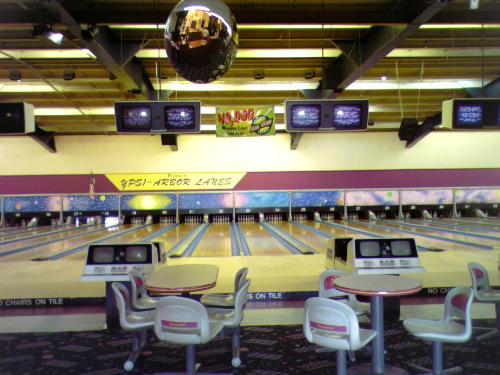
Most bowling centers have multiple bowling lanes, each of which is a set size and shape. As shown in the picture to the left, rental of a bowling lane also comes with a section to sit and keep score. Different centers vary in terms of the amount of space one gets along with the rental of a lane, as well as the distance between lanes. One game consists of ten frames, where each bowler is given up to two chances to knock down as many of the ten pins at the end of the lane as possible. Please click here for more information on bowling rules and regulations. Due to the nature of bowling as a sport, in the past many bowling centers have charged customers by the number of games they have played. Over time, bowling has begun to be perceived as more of a social activity and less of a sport, which is what allowed some of the newer companies to start charging hourly rates instead. For these newer centers, where demand exceeds the amount of lanes at given times, control over play by the hour can allow them to better schedule their lanes in advance to customers.

Bowling centers make most of their money through rental of each lane, but there are some ancillary products as well. First, it is mandatory to wear bowling shoes at most centers. For those players who do not own shoes (all but the experienced player), they have to rent shoes from the center. In addition, many sell food and beverages (including alcohol). Smaller revenue generators can include a bowling accessory shop, repair center, jukebox, and arcade games. Bowling centers that have recently been renovated or newly built will usually house a bowling alley inside an “entertainment center” – where patrons have many ways to interact with the establishment in addition to just bowling. Below I’ll discuss four different bowling centers that exist today. While these four are not meant to be representative of the industry as a whole in any way, they should give you a indication of its current standing, as well as recent innovations and trends.

Helen Newman Bowling Center includes 16 bowling lanes and is located on the Cornell University campus in Ithaca, NY. In addition to bowling, customers can also buy food and beverages (including beer) and play arcade games. During set times during the week (mostly off-peak times), there are leagues that are keeping the lanes used. Their traditional hours are 5pm until anywhere between 11pm and 1am Monday through Saturday. Rates are charged either per person per game ($2 off-peak, $2.25 peak) or per lane ($12 peak, $14 peak).

Brunswick Bowling is both a supplier of bowling products as well as a chain of bowling alleys. Many of their facilities are getting old and run down. In the midst of their renovations, Brunswick has differentiated these centers by calling them either Brunswick Recreation Centers (not yet renovated) or Brunswick Zone/Zone XL (renovated). For many of the Recreation Centers, supply many times exceeds demand and so tight control over time is not needed as much here. Each Brunswick Center/Zone is operated separately with its own pricing, but the handful that I called only offered pricing per game, not by the hour. You can see this by going to their homepage, as they suggest the many times in which you might want to use their bowling centers (“Brunswick Team Challenge”, birthday parties, graduation parties, etc.). One interesting thing was their call-to-attention of short season leagues. Many traditional leagues require players to attend for over 30 weeks of play, but Brunswick offers seasonal options to all ages.

Lucky Strike Lanes began in Hollywood, CA in 2003 and is currently a chain of eighteen bowling centers across the US. Most of these are situated in areas where foot-traffic is high and people are looking for something to do during the evening. In their West Nyack, NY location, for instance, the bowling center is located within the Palisades Mall along with an ice skating rink, movie theater, and Dave and Buster’s. In Washington, DC, it has a street side location nested between a movie theater, various dining venues, and Verizon Center. Rates are determined by each separate location, and separate rate has been determined by day of week and by time of day. For those wishing to make reservations (a must at peak hours), only hourly lane rentals are allowed (ranging from $55-$75 per hour). Walk-in customers wishing to use lanes that would otherwise go to waste are allowed to pay per game (ranging from $4.95-$7.95 per hour). Lucky Strike Lanes also includes billiards, and extensive bar (all patrons after 9pm must be 21+, which further increases revenues) and food menu.

AMF is another large bowling chain that is struggling to keep its brand relevant with today’s bowlers. To address this, they have launched two new concepts for bowling centers: 300, an upscale bowling center, and Avenue E, which includes other forms of entertainment and gourmet food for people of all ages. 300 currently has six locations in the US – some are brand new locations and others are retrofitted from AMF centers. 300 charges customers per person per game, ranging from $8-$11 depending on the time of day and day of week. Like other new concepts, such as Lucky Strike Lanes, 300 also features upscale cocktails and an extensive menu.