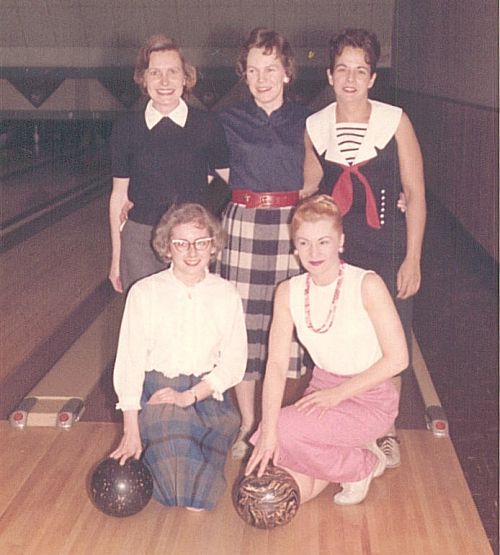
 Bowling became a popular activity in the US in the 1940s-60s. While the industry took off and became a financially viable business plan due to the stable business of bowling leagues, the $4 billion (US) industry has taken off recently once again due to the creation of entertainment centers and the idea that bowling is a family-friendly sport and an option for the casual bowler.
 Most bowling centers have multiple bowling lanes, each of which is a set size and shape. As shown in the picture to the left, rental of a bowling lane also comes with a section to sit and keep score. Different centers va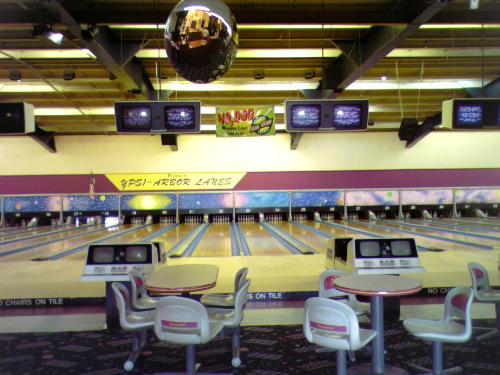 ry in terms of the amount of space one gets along with the rental of a lane, as well as the distance between lanes. One game consists of ten frames, where each bowler is given up to two chances to knock down as many of the ten pins at the end of the lane as possible. Please click here for more information on bowling rules and regulations. Due to the nature of bowling as a sport, in the past many bowling centers have charged customers by the number of games they have played. Over time, bowling has begun to be perceived as more of a social activity and less of a sport, which is what allowed some of the newer companies to start charging hourly rates instead. For these newer centers, where demand exceeds the amount of lanes at given times, control over play by the hour can allow them to better schedule their lanes in advance to customers.
Bowling centers make most of their money through rental of each lane, but there are some ancillary products as well. First, it is mandatory to wear bowling shoes at most centers. For those players who do not own shoes (all but the experienced player), they have to rent sho es from the center. In addition, many sell food and beverages (including alcohol). Smaller revenue generators can include a bowling accessory shop, repair center, jukebox, and arcade games. Bowling centers that have recently been renovated or newly built will usually house a bowling alley inside an “entertainment center” – where patrons have many ways to interact with the establishment in addition to just bowling. Below I’ll discuss four different bowling centers that exist today. While these four are not meant to be representative of the industry as a whole in any way, they should give you a indication of its current standing, as well as recent innovations and trends.
Helen Newman Bowling Center includes 16 bowling lanes and is located on the Cornell Unive rsity campus in Ithaca, NY. In addition to bowling, customers can also buy food and beverages (including beer) and play arcade games. During set times during the week (mostly off-peak times), there are leagues that are keeping the lanes used. Their traditional hours are 5pm until anywhere between 11pm and 1am Monday through Saturday. Rates are charged either per person per game ($2 off-peak, $2.25 peak) or per lane ($12 peak, $14 peak).
 ick Bowling is both a supplier of bowling products as well as a chain of bowling alleys. Many of their facilities are getting old and run down. In the midst of their renovations, Brunswick has differentiated these centers by calling them either Brunswick Recreation Centers (not yet renovated) or Brunswick Zone/Zone XL (renovated). For many of the Recreation Centers, supply many times exceeds demand and so tight control over time is not needed as much here. Each Brunswick Center/Zone is operated separately with its own pricing, but the handful that I called only offered pricing per game, not by the hour. You can see this by going to their homepage, as they suggest the many times in which you might want to use their bowling centers (“Brunswick Team Challenge”, birthday parties, graduation parties, etc.). One interesting thing was their call-to-attention of short season leagues. Many traditional leagues require players to attend for over 30 weeks of play, but Brunswick offers seasonal options to all ages.
Lucky Strike Lanes began in Hollywood, CA in 2003 and is currently  a chain of eighteen bowling centers across the US. Most of these are situated in areas where foot-traffic is high and people are looking for something to do during the evening. In their West Nyack, NY location, for instance, the bowling center is located within the Palisades Mall along with an ice skating rink, movie theater, and Dave and Buster’s. In Washington, DC, it has a street side location nested between a movie theater, various dining venues, and Verizon Center. Rates are determined by each separate location, and separate rate has been determined by day of week and by time of day. For those wishing to make reservations (a must at peak hours), only hourly lane rentals are allowed (ranging from $55-$75 per hour). Walk-in customers wishing to use lanes that would otherwise go to waste are allowed to pay per game (ranging from $4.95-$7.95 per hour). Lucky Strike Lanes also includes billiards, and extensive bar (all patrons after 9pm must be 21+, which further increases revenues) and food menu.
AMF is anot her large bowling chain that is struggling to keep its brand relevant with today’s bowlers. To address this, they have launched two new concepts for bowling centers: 300, an upscale bowling center, and Avenue E, which includes other forms of entertainment and gourmet food for people of all ages. 300
 currently has six locations in the US – some are brand new locations and others are retrofitted from AMF centers. 300 charges customers per person per game, ranging from $8-$11 depending on the time of day and day of week. Like other new concepts, such as Lucky Strike Lanes, 300 also features upscale cocktails and an extensive menu.

2 comments:
How long do you think it will take before other bowling alley companies start following the lucky strike lead? It would be interesting to see how customers have reacted to lucky strike. LIz, you said you'd been there--what would you say?
Also, look at the different ancillary revenue opportunities--f&b, shoes, other retail--can you think of others that could be offered?
And, it does seem like a lot of bowling alleys use league play etc. to help fill low demand periods.
I've never actually been to Lucky Strike. The one time I tried to go in DC, they said we needed reservations in advance at what I considered to be too expensive of a rate per hour to be worthwhile. We basically boycotted the place ever since. There's still plenty of people willing to pay the price however, so they haven't suffered any.
The only other "ancillary revenue" I could think of came from Entertainment Centers - where I'm not really sure which is the ancillary revenue anymore - the other items, or the bowling itself! The all-in-one destination spots seem to try to provide a little bit of something for everyone.
Post a Comment